

You already know who the family offices are.
You’ve got the “170+ Family Offices Cutting Pre-Seed Cheques” open in another tab, maybe even colour‑coded by ticket size and geography. You’ve had some calls. A few liked you. Someone even said, “Keep us posted.”
And yet…no Termsheet.
This edition is about that annoying gap between “we like what you’re building” and “here’s the cheque.” Not by giving you another list of names, but by fixing the thing that blocks most of these cheques:
How your round is designed.
Think of this as the prequel to the investor list. That one was who to talk to. This one is how to structure the talk to increase chances.
Table of Contents
Why Family Office Money Feels Close But Hard to Close
How Family Offices Invest in Startups vs Venture Capital Funds
The Three Main Channels Family Offices Use (Direct, Co‑Invest, Funds)
What a Family‑Office‑Friendly Pre‑Seed / Seed Round Looks Like
How to Structure a Round That Works for Both Family Offices and VCs
What Family Offices Look for in Startup Investments
How to Use the 170+ Family Offices List with This Framework
FAQ: Raising from Family Offices at Pre‑Seed and Seed
Upgrade to unlock the full library of funding resources and cut your fundraising time in half.
Why family office money feels close, but doesn’t land
In my experience while helping founders raise, I’ve seen this pattern a lot.
The founder raises a small angel SAFE. Gets into a decent accelerator. Sees venture slow down. Realises family offices are now doing a surprising share of early-stage deals. (In some markets, families account for 40%+ of new sub‑Series B cheques.)
They hustle intros off that list, do five or six Zooms, answer questions thoughtfully, and send a clean deck.
Then the emails start:
“Love what you’re building, but we’d like to see a lead first.”
“Happy to co‑invest once someone sets terms.”
“Let’s stay in touch for the next round.”
On paper, it sounds like “too early.” In reality, it’s:
“We can’t see where we fit into this round, and we don’t want to be the only adults in the room.”
The problem isn’t the story here. Most of the time, it’s the structure.
How family offices invest in startups (vs how VCs do)
Let’s separate two things: the vehicle and the brain inside it.
A VC fund is a time‑boxed machine. It’s a job in the end.
Ten‑year fund life. LPs to report to. Ownership targets. The job is turning LP money into high returns on a set schedule.
A family office is the opposite. It’s a balance sheet. No fund life. No LPs. The intention is to compound wealth and preserve it for another generation.
That difference shows up in their portfolio too.
Recent surveys show that globally, roughly 40–50% of family office assets now sit in “alternatives”: private equity, venture, real estate, hedge funds, private credit, and real assets. The remaining ~50–60% is in public equities, bonds, and cash.
One large sample of single-family offices found that two‑thirds plan to increase exposure to private equity funds in the next 12 months, and ~69% plan to increase direct private equity investments.
So they are not dabbling. They are deliberately increasing their private market exposure.
But their priorities are not “VC priorities”:
They’d like upside, sure. But capital preservation is the top priority.
They care about fit with the rest of their assets: geographies they know, sectors they’ve operated in, and themes they want to be long. Hence, you might often see them invest in rather boring business than alwats following the trend like VCs.
They don’t have to exist in year 7 because an LP memo needs it.
If you pitch them the way you pitch a seed fund, you are probably answering the wrong exam.
The three channels they actually use to back startups
In the last newsletter, we mapped out who these 170+ family offices are. What that list doesn’t show you is how the money moves.
It usually flows through three pipes:
1. Direct deals
This is the most popular one.… single family office wiring directly into your cap table.
Direct deals usually come from single-family offices with at least a small in‑house team. They will:
Run proper diligence.
Want access to your data room.
Sometimes syndicate in another family or a friendly VC.
From your side, this looks similar to raising from a late‑stage angel/solo GP, but with a larger cheque and longer time horizon.
2. Co‑investments and club deals
This is the under‑appreciated majority.
Across multiple surveys, 60–75% of family office transaction volume is now “club deals” or co‑investments….families teaming up with other families, PE/VC funds, or trusted partners.
Instead of “one family, one deal,” it’s:
“Three families plus a sector fund co‑invest together, each taking a slice.”
Why? Because:
It spreads risk.
It gives them access to larger, more complex deals.
It lets them lean on others’ sector expertise and diligence.
If your round doesn’t signal who’s doing the heavy lifting, it’s hard for them to see it as a co‑invest opportunity.
3. Via VC funds (“partner funds”)
Some families prefer backing specialist GPs and then co‑investing selectively into those funds’ best deals.
You may not even know a family is behind your lead VC, but they might show up in your cap table later as a co‑invest, once your fund calls them and says, “We’re doing a larger round here, want in?”
What a family‑office‑friendly pre‑seed / seed round looks like (with numbers)
Let’s talk about the thing you’re actually raising.
You’re likely somewhere between late pre‑seed and early seed. The round is $1.5–3M. You have:
A product or strong prototype.
Some early usage or revenue.
Enough signal that this isn’t a pure “idea on a napkin.”
At that size, what does a family‑office‑friendly round roughly look like?
Most family offices playing this early are writing:
$100–250K cheques at pre‑seed, into rounds of $750K–1.5M.
$150–500K cheques at seed, into rounds of $1.5–3M.
They don’t want to be:
The only institution.
The de facto lead.
The person all other investors are “waiting on.”
They’re happiest when they can say internally:
“XYZ Seed Fund is leading. We like this sector, we like this founder, we’ll take a $250–400K slice and see how it plays out. If it works, we lean in.”
On terms, they’re more conservative than many seed funds, but in a founder‑friendly way:
A straightforward priced round with 1x non‑participating liquidation preference, or
A standard YC‑style SAFE/convertible with a realistic cap, no exotic side notes.
Do note: They run away from complex deal structures, where there are waiting SAFEs or multiple investors and different valuations or overseas investments, with no clear investing pathway
You’ll hear this from emerging managers raising from families, too: boring, clean, consistent beats “innovative” every time.
Your seed might still be messy in your head. You want optionality, but they want legibility.
How to structure a round that works for both family offices and VCs
Now the important part: making your round work for both.
Can a family office lead your round? Yes. Should you design for that by default? In most cases, no.
At pre‑seed and seed, the cleanest pattern tends to be:
A sector‑specialist VC or serious operator‑led fund as lead.
A small layer of operators/angels who know your buyer.
1–3 families as patients, long‑term co‑investors.
If you’re raising $2M, a sensible skeleton might be:
Lead VC: $1.1–1.3M
Angels/operator funds: $250–400K
Family offices: $300–600K split across 1–3 names
Not because those exact numbers are “right,” but because:
There’s a clear adult setting terms and doing heavy diligence.
Family offices are not 70% of the round.
Your Series A investor later sees a coherent story, not a Christmas tree of small cheques and conflicting rights.
When you walk into a family office meeting with that structure, your positioning sounds like:
“We’re raising a $2M seed. [Lead fund] is committing $1.2M at [terms]. We’re reserving $400–500K for 2–3 families who like [sector/geo] and can be patient, long‑term partners. We’d like you to be one of them.”
You’ve told them their role. You’ve told them who else is in the room. You’ve told them where the risky work is being done.
On terms, where can you flex?
Pro‑rata rights? Reasonable.
Information rights? Yes, in line with other institutional cheques.
A board observer for a family that brings sector access? Could be a plus.
Where you shouldn’t flex:
Giving one $150K cheque “super‑preferred” downside that nobody else has.
Letting a single investor negotiate control rights out of proportion to their stake.
Agreeing to terms you already know will make your next round’s counsel sigh.
The test: would you be able to share a single term sheet with your future Series A investor and say, “Everyone in the seed is on this paper”? If not, you’re creating future debugging work.
What family offices are quietly optimising for
Here’s the part that founders underestimate.
A VC has to sell your deal to an IC and then to LPs. A family office investment head has to sell their deal to:
The principal(s).
Other family members (often across generations).
Sometimes, a small internal committee.
They are optimising for at least three things:
1. Portfolio fit and risk sizing
In many families, your cheque is maybe 0.1–0.5% of NAV, but 5–10% of their “startup bucket.” That means it needs to be risky enough to matter, but not so risky it looks irresponsible.
So they look at:
Stage: “Is this pure idea risk, or is something validated?”
Sector: “Do we already understand this, or can we learn quickly?”
Structure: “If it all goes sideways, are we stuck in something ugly?”
If your claim is “we need $3M pre‑product to just ‘go fast’,” that’s a harder sell in this environment.
2. The internal story
Families have a story about how their wealth was built. Logistics. Real estate. Steel. IT services. Banking.
They also have a story about where they want to be long: climate, AI infra, healthcare, education, domestic manufacturing.
If you can help an investment head say, in one sentence:
“We made our money in [X], this gives us long‑dated exposure to the future of [X or adjacent Y], with a team that understands it,”
you’re 5x ahead of the founder whose deck could be about anything.
That’s not IRR talk. That’s identity talk.
3. Governance comfort
They don’t expect you to behave like a listed company. But they do expect:
Clean incorporation and cap table.
No stealth regulatory time bombs.
A basic reporting rhythm: quarterly updates, big changes flagged early.
If you’re touching regulated sectors (FinTech, health, climate infra, defense), this weighs more heavily. “We’ll figure regulation out later” is not comforting to people whose worst nightmares start with three letters: RBI, SEBI, SEC, FDA.
You don’t need a 40‑page governance deck. You do need to show that you’ve thought about risk like an adult.
How to use the 170+ family offices list with this framework
If you’ve read this far, you’re probably already on that previous article.
Treat the two as a bundle:
The list (“170+ Family Offices Cutting Pre‑Seed Cheques”) is your who.
It tells you which families like what sectors, what geos, and what cheque sizes.This playbook is your how.
It tells you how to design a round and a narrative that these same names can cleanly plug into.
A simple way to use both:
Go back to the list and circle 5–10 families that genuinely match your sector, geography, and cheque size.
Decide your round shape before outreach: who’s leading, what’s the target, and how much space you want to leave for families.
Update your deck with a simple slide: “Why this works for a family office,” in their language:
downside moderation,
thematic fit,
clean structure,
option to follow up if it works.
Then, and only then, start introductions—ideally via people they already trust (other founders, their lawyers, GPs they back).
If you haven’t read Part 1 yet, here’s the link again:

Use that for targeting. Use this for design.
Other Fundraising Resources
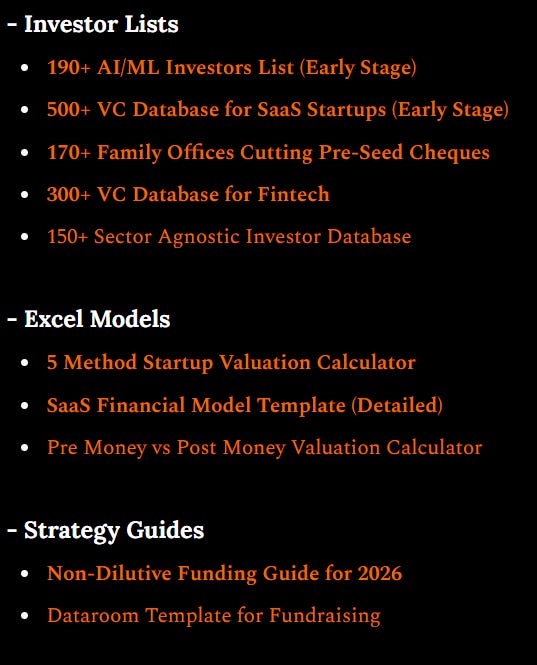
Check it out here :
FAQs
1. What is a typical family office cheque size at pre‑seed and seed?
Most family offices that play early write $100–250K cheques at pre‑seed and $150–500K cheques at seed, usually into $1.5–3M rounds rather than trying to be the only major investor in a tiny SAFE.
2. How is raising from a family office different from raising from VCs?
VCs manage 10‑year funds with LP pressure and specific ownership targets, so they optimise for speed, follow‑on, and eventual DPI. Family offices manage permanent capital, with roughly 40–50% of portfolios in alternatives (including private equity and venture), and care more about capital preservation, thematic fit, and governance than hitting a specific IRR by a fixed date.
3. Can a family office lead my seed round? Should they?
A large, sophisticated single-family office can lead, especially if they know your sector intimately. But at pre‑seed/seed, it’s usually cleaner to have a specialist VC or operator‑led fund set terms and then invite families in as co‑investors—this matches their preference for club deals, which now account for ~70%+ of FO transactions in some markets.
4. What terms do family offices usually expect in startup deals?
They’re generally comfortable with straightforward priced rounds (1x non‑participating liquidation preference) or standard SAFEs/convertibles at realistic caps, plus basic information and pro‑rata rights. They tend to avoid stacked notes, exotic preferences, or bespoke downside protection for small cheques, because those structures are hard to justify internally and can create problems in later rounds.
5. How do I find and contact family offices that invest in startups?
The most effective routes are curated lists (like the 170+ family offices resource), warm introductions through founders they’ve backed, lawyers, private bankers or GPs they’re LPs with, and outreach that clearly explains why your sector, geography, and risk profile match their mandate—rather than generic “we’re raising, are you in?” blasts. Surveys show 7 out of 10 family offices now do direct or co‑invest deals, but they still prefer trusted networks over cold inbound.
Until next time, keep building!
P.S. Forward this to any founder friends who might be fundraising—they’ll appreciate the clarity.
If you like reading My Unicorn Club - The Startup Newsletter - spread the word and share it with someone who might need it :)
Sayanee - are family offices a niche for you? I'm super interested in the couple of things - my Substack strategy is to build founder tools (have 20, announcing them 2 per week & aim to have 50 by year end). The team would be interested in building a "Raise from Family Office" Tool to add to the Tool box. Maybe something we could collaborate on. Separately - I'm heavily weighted to VC/PE and so been diversifying into super scarce classic cars - getting 15% IRR and in the UK its a tax free return - my people are the world experts and run 600 data points on any vehicle so it's a pretty insane model. You might find them interesting if family offices is your niche.